

Coconut Fiber: Indonesia’s Untapped Goldmine Poised to Transform the Wood Panel Industry
Coconut Fiber: Indonesia’s Untapped Goldmine Poised to Transform the Wood Panel Industry
- 07 May 2026, 10:00
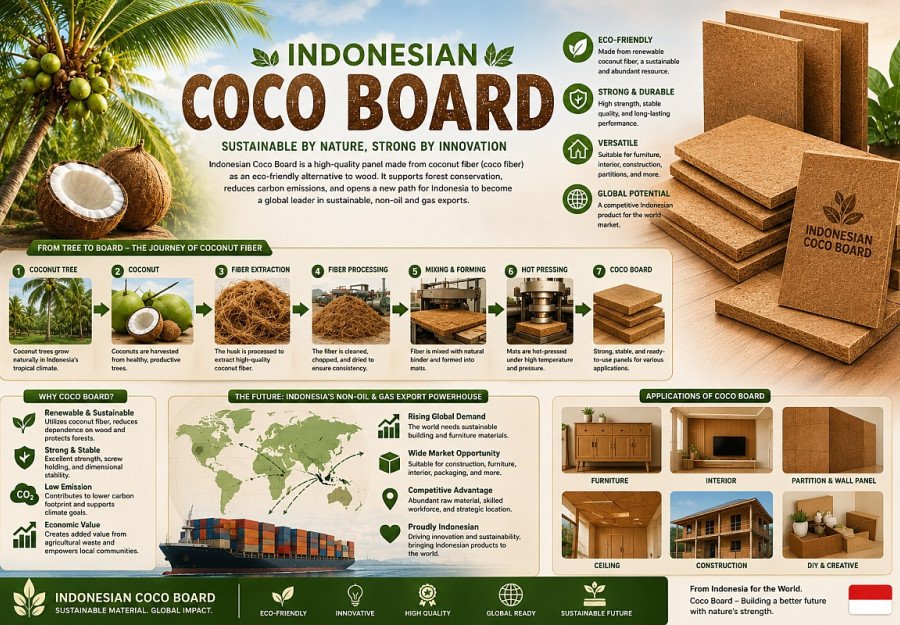
Coconut Fiber: Indonesia’s Untapped Goldmine Poised to Transform the Wood Panel Industry
From coconut plantations in Riau to wood-panel factories in Java, coconut fiber is emerging as a promising alternative raw material for Indonesia’s next generation of sustainable industrial products. More than 75% of its potential is still wasted—burned or left to rot. Now, the Indonesian government is moving to turn that overlooked agricultural residue into a multi-billion-dollar export opportunity.
Jakarta, May 2026 — APKINDONews
Behind Indonesia’s vast 3.7 million hectares of coconut plantations stretching from Riau to Papua lies a largely overlooked industrial opportunity. Every year, the country produces between 17 and 18 billion coconuts, making Indonesia the world’s largest coconut producer. Yet ironically, the coconut husk—which accounts for roughly 35% of the fruit’s weight—has long been treated as little more than waste, often burned in fields or abandoned with virtually no economic value.
Conservative estimates suggest that Indonesia has the potential to generate between 850,000 and 2.2 million tons of processable coconut fiber, or cocofiber, annually. In reality, however, only around 15% to 25% of that potential is currently utilized. More than three-quarters of this valuable raw material continues to be discarded, burned, or sold as a low-value commodity with minimal downstream processing.
Indonesia’s Ministry of Industry is now attempting to reverse that trend. Through the Directorate of Forest and Plantation Product Industries, the government has begun actively promoting policies and industrial studies aimed at positioning coconut fiber as a competitive alternative raw material for the country’s wood panel industry—a strategic sector that has long relied heavily on forest timber and is increasingly facing supply constraints.
A Wood Panel Industry Searching for Alternatives
Indonesia’s wood panel industry—including plywood, MDF, particle board, and related products—remains one of the country’s most important non-oil-and-gas export sectors. But the industry faces mounting structural pressures: tightening timber supplies, growing global scrutiny over deforestation, increasingly stringent environmental certification requirements, and evolving forestry regulations aimed at protecting natural forests.
Coconut fiber is emerging as one of the most viable answers to that challenge.
Unlike many alternative materials that require new plantations or imported feedstock, coconut fiber is a byproduct of an already established agricultural commodity with nationwide production and deeply rooted supply chains across the archipelago.
Through various inter-ministerial coordination forums, the Ministry of Industry has repeatedly emphasized that the issue is not raw material availability, but rather processing technology, infrastructure readiness, and supportive industrial policy. Those areas have now become the government’s primary focus.
Abundant, Affordable, and Technically Competitive
One of cocofiber’s greatest advantages is its cost competitiveness. At the farm level, coconut fiber is priced at approximately Rp800 to Rp1,500 per kilogram—significantly cheaper than synthetic fibers such as glass fiber or polypropylene, whose prices fluctuate alongside global oil markets.
But affordability is only part of the story.
Coconut fiber possesses a remarkably attractive technical profile. Its lignin content ranges between 40% and 45%—the highest among commercially known natural fibers. Lignin acts as a natural binding agent, allowing the fiber to bond more effectively with resin during panel production and reducing the amount of synthetic adhesive required.
Its tensile strength, ranging from 95 to 118 MPa, is comparable to the softwoods commonly used in panel manufacturing. More importantly, coconut fiber offers exceptionally high elongation properties—between 15% and 51%, far exceeding the 1% to 3% typically found in wood. This elasticity enables cocofiber-based panels to absorb impacts and vibrations more effectively, making them particularly attractive for furniture and automotive applications.
The material also offers natural resistance to termites and fungal attacks—an especially valuable characteristic in tropical climates such as Indonesia’s, where biological degradation remains a persistent challenge for buildings and furniture products.
In an era increasingly shaped by sustainability standards, cocofiber’s biodegradable and renewable characteristics provide an additional competitive advantage.
Standards Already Exist—But Industrial Adoption Lags Behind
One often-overlooked fact is that Indonesia already has a national standard for coconut fiber.
In 1999, the National Standardization Agency (BSN) introduced SNI 01-6095-1999, which established quality specifications, classification methods, packaging, and labeling requirements for coconut fiber products.
Meanwhile, research institutions and universities across Indonesia have conducted extensive studies on cocofiber-based panels using references such as SNI 03-2105-2006, the national standard governing particle board density and thickness expansion.
Earlier studies have even demonstrated that coconut-fiber composite boards can meet Indonesia’s formal particle-board standards.
In other words, cocofiber-based panel products are not foreign to Indonesia’s industrial and regulatory ecosystem. What has been missing is formal industrial recognition, large-scale commercialization, and product-specific technical standards for applications such as coco board, coconut-fiber particle board, and cement-bonded cocofiber panels.
The development of dedicated standards for these products is now considered one of the government’s most urgent industrial priorities.
Proven Products Already Exist
The technology required to transform coconut fiber into industrial panels is no longer theoretical.
India’s Coir Board has successfully commercialized coco board, coir particle board, and rubberized coir panels at industrial scale for years. Sri Lanka has already exported environmentally certified cocofiber panels to Europe and Japan.
Indonesia is not starting from scratch.
Research centers under the Ministry of Industry, along with institutions such as Bogor Agricultural University and Gadjah Mada University, have already developed cocofiber composite panel prototypes. Small and medium-sized enterprises in Java and Sulawesi are producing cement-bonded coconut-fiber panels for small-scale construction.
In the automotive sector, domestic component manufacturers have long processed coconut fiber into interior vehicle components, with major manufacturers such as Toyota Motor Manufacturing Indonesia already utilizing cocofiber-based materials.
At least six commercially viable panel products have already been proven feasible:
-
Coco board (hot-pressed coconut fiber and resin)
-
Coconut particle board
-
Hybrid wood-coconut composite panels
-
Coco-MDF
-
Cement-bonded cocofiber panels
-
Coconut-fiber mat sheets for plywood core layers
TKDN Policy Opens a Strategic Window
A major catalyst for the industry may come from Indonesia’s domestic-content policy framework, known as TKDN (Tingkat Komponen Dalam Negeri).
Industry Minister Agus Gumiwang Kartasasmita recently launched sweeping TKDN reforms through Ministerial Regulation No. 35/2025, aimed at strengthening downstream industries and reducing import dependence.
Under the policy, government procurement projects must prioritize domestically produced goods if local-content requirements exceed 40%.
Because cocofiber panels are made almost entirely from domestic raw materials, their TKDN scores could significantly exceed that threshold—making them highly competitive for public procurement projects worth hundreds of trillions of rupiah annually.
The government has also begun formally identifying key domestic components across industrial sectors, opening the door for coconut fiber to gain official recognition as a strategic industrial input.
A Market Waiting to Be Captured
The market opportunity for cocofiber-based panels spans both domestic and export markets.
Within Indonesia, the country’s furniture and interior-design industry—valued at an estimated Rp40 trillion to Rp60 trillion annually—represents a massive potential market. Cocofiber panels could partially replace imported MDF and particle board products in furniture manufacturing, office partitions, and storage systems.
Meanwhile, Indonesia’s ambitious subsidized housing program—targeting more than one million homes annually—could create substantial demand for cement-bonded cocofiber panels as fire-resistant, termite-resistant, and moisture-resistant building materials.
Globally, the opportunity may be even larger.
Demand for environmentally friendly construction materials is expanding rapidly across Europe, the United States, Japan, Australia, and the Middle East. The European Union’s green-building materials market alone is growing between 6% and 8% annually.
A potentially transformative catalyst could arrive in 2027, when the Indonesia-European Union Comprehensive Economic Partnership Agreement (IEU-CEPA) is expected to take effect, granting Indonesian panel products zero-tariff access to EU markets.
For cocofiber panels carrying internationally recognized eco-label certifications, the combination of zero tariffs and sustainability premiums could create a powerful competitive advantage.
Over the long term, Indonesia could potentially generate more than $300 million annually in exports from natural-fiber panel products if the sector is developed seriously.
Challenges Cannot Be Ignored
Despite the optimism, significant obstacles remain.
Industrial-scale cocofiber panel technology remains underdeveloped in Indonesia. Most domestic cocofiber processors still focus on relatively low-value products such as mattresses, automotive seats, and horticultural growing media.
Raw-material quality also remains inconsistent across regions, while collection and processing infrastructure in major coconut-producing provinces such as Riau, North Sulawesi, and Maluku remains inadequate.
There is also a strategic risk: if Indonesia continues exporting raw coconut husks without downstream processing, domestic industries could eventually face feedstock shortages.
Finally, cocofiber’s modulus of elasticity remains lower than wood fiber, meaning certain high-rigidity applications may still require hybrid composite formulations.
Beyond Economics: A Circular-Economy Opportunity
Beyond industrial economics, cocofiber development carries major environmental implications.
Transforming coconut husks into industrial products would significantly reduce open-field burning and associated carbon emissions. Replacing part of the wood supply chain with agricultural waste would also help ease pressure on natural forests.
In the context of the global circular economy, coconut fiber represents a near-perfect example of agricultural waste converted into high-value industrial products with a substantially lower carbon footprint than fossil-based or timber-intensive alternatives.
Potential carbon-credit mechanisms could eventually create additional revenue streams for both manufacturers and coconut farmers.
The Message from a Forgotten Resource
For decades, Indonesia treated coconut husks as worthless residue.
Today, global markets are changing. Demand for sustainable materials is accelerating. Trade policies increasingly favor environmentally friendly products. Domestic-content reforms are opening new opportunities for locally sourced industrial materials. And Indonesia already possesses the raw material base, early technological foundation, and regulatory groundwork needed to build a globally competitive cocofiber industry.
Coconut fiber now stands at the intersection of every major industrial trend shaping the future: sustainability, circular economy development, local-content manufacturing, and green exports.
The raw materials exist.
The market exists.
The technology exists.
The standards partially exist.
What remains is the political and industrial commitment to move forward consistently—and at scale. (geo_rob)
APKINDONews